
Discoveries from Central and Eastern Europe at URANIA CEENEMA!
An exceptional highlight in September is the launch of the new ‘Viennale Goes CEE’ series – in collaboration with URANIA CEENEMA. Together, we’ve selected some fantastic films with links to Central and Eastern Europe from past editions of the Viennale. A sort of ‘CEE Best of’ from the Viennale – featuring films that transcend borders, open up new perspectives, and tell a wide variety of stories from our region.
WOMEN DO CRY
Mina Mileva/Vesela Kazakova
Bulgaria, France 2021, 107 min
Sat, 12.9., 8 PM
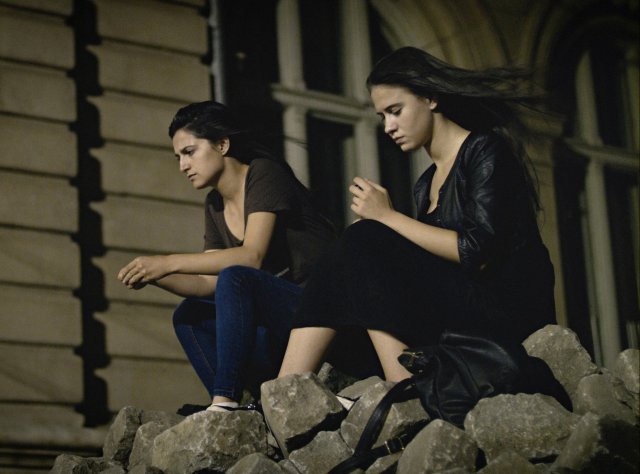
In this defiant, piquant dramedy, a promising musician named Sonja learns that she’s contracted HIV. After she drops out of the music conservatory, Sonja is helped out by her practical sister Lora, who supports the family by working as a crane operator, and their hapless mom Ana. Sonja’s crisis brings together two generations of women: sisters and aunts who’ve experienced relentless misogyny, shaming, and homophobia in turn. The women also share the trauma of violence in their own family, which slowly resurfaces the more time they spend together, learning to speak out and to grieve. Kazakova and Mileva craft a bristling social critique that still leaves room for mordant comedy and warmth, relishing the young women’s sisterly intimacy, melodramatic outbursts, and tongue-in- cheek outspokenness about their sex lives. In one scene, the two sisters sit atop a pile of rubble on a construction site, a gently absurdist sight that also sums up the director’s approach – surprising, often strident, but never belabored. Meanwhile, folkloric touches – such as the popular Eastern European story of a stork bringing babies – put a fantastical twist on this story about the limits of human reason and the boundlessness of love. (Ela Bittencourt)

Kuru otlar üstüne (About Dry Grasses)
Nuri Bilge Ceylan
Germany, France, Qatar, Sweden, Turkey 2023, 197 min
Sun, 13.9., 6 PM
As the hopes attached to this year’s Turkish election recede, KURU OTLAR ÜSTÜNE begins to feel like some sort of historical document, a proudly cerebral state-of-the-nation address from an era already consigned to the past. Yet the myriad insights of Nuri Bilge Ceylan’s ninth feature are also timeless, like his ability to craft a level of novelistic detail rarely seen in cinema; the snowy, emptied-out landscapes of Eastern Anatolia themselves resemble the blank pages of a book. Its first lines sketch out the life of an unsatisfied art teacher called Samet, who is adored by his students but dreams of being reassigned to Istanbul, which explains his relative lack of interest in Nurey, an art teacher from a nearby city rebuilding her life after losing her leg in a suicide bombing. When Samet’s favouritism triggers a scandal at school, the resultant discussions appear to take centre stage, although they turn out to be just one set of conversations among so many, all aimed at probing the pluralism, complexity and inconsistency of Turkish society today; it’s an idea best summed up by Nurey herself in one of this spectacularly articulate film’s many astute turns of phrase. “Everything beautiful in this world gets stuck in the webs we weave.” (James Lattimer)
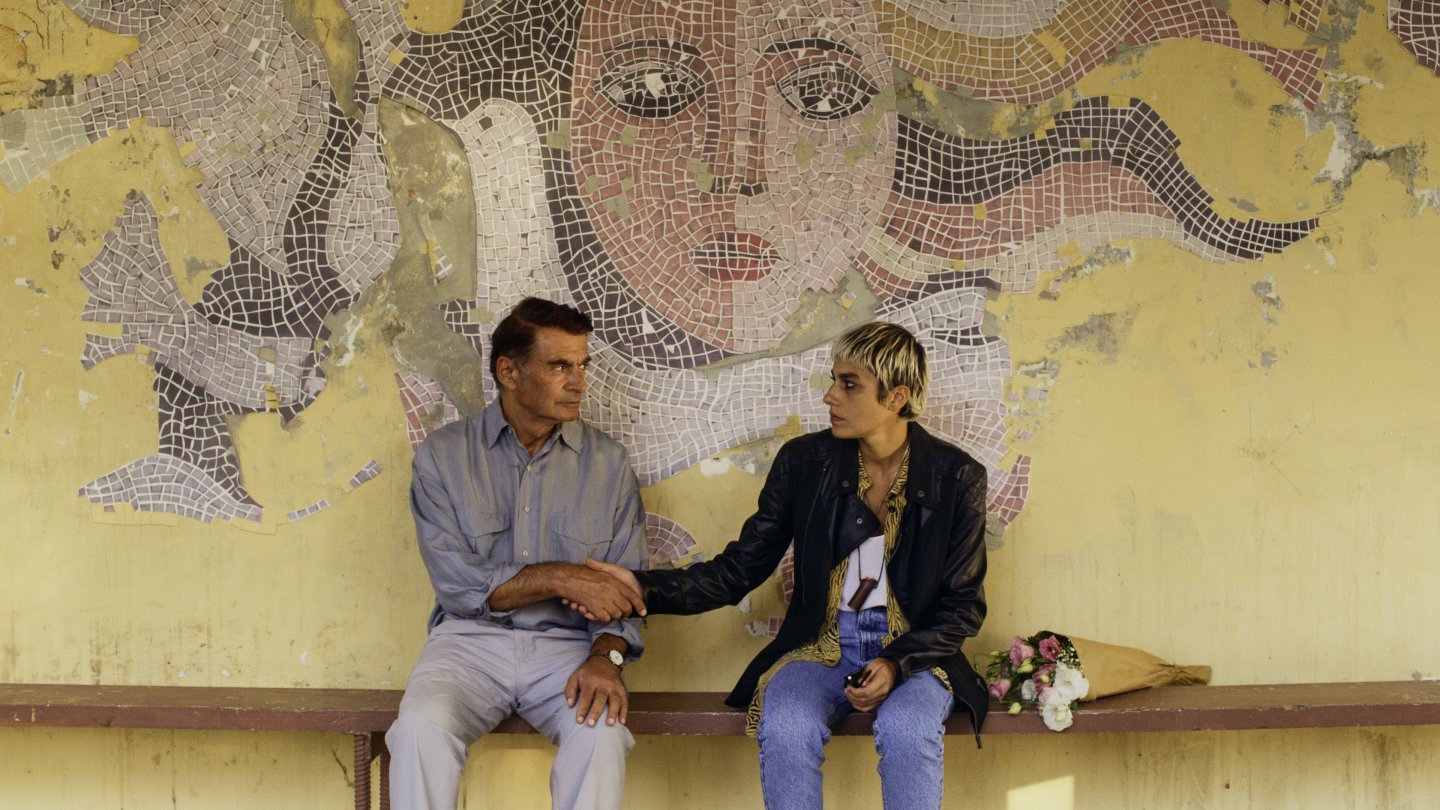
WET SAND
Elene Naveriani
Switzerland, Georgia 2021, 115 min
Fri, 18.9., 6 PM
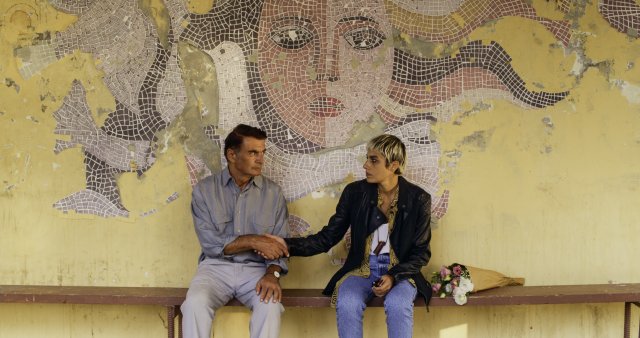
When Georgia attained independence in 1991, the country’s film industry began to flourish almost immediately. However, it has been in the last decade and a half that bevy of new voices has emerged, suggesting that we are in the midst of a Georgian New Wave. Following 2017’s acclaimed featurette I AM TRULY A DROP OF SUN ON EARTH, Elene Naveriani returns with a downcast but beautifully detailed film about the persistence of love under the shadow of Christian fundamentalism. WET SAND considers secrets and prejudices in a small, insular village on the Black Sea. Beginning with the death of Eliko, an old man long viewed with suspicion by the other villagers, the seemingly tight-knit community must outwardly acknowledge the rigid conformism their way of life has always tacitly demanded. Following the arrival of Moe, Eliko’s granddaughter from Tbilisi, some of the village’s black sheep – especially Amnon, owner of a popular seaside bar – are no longer able to hide in the shadows. With its unblinking consideration of violent provincialism, WET SAND recalls the work of Jane Campion and further establishes Naveriani as a talent to watch. (Michael Sicinski)
Magyarázat mindenre (Explanation For Everything)
Gábor Reisz
Hungary, Slovakia 2023, 152 min
Sun, 20.9., 7:45 PM
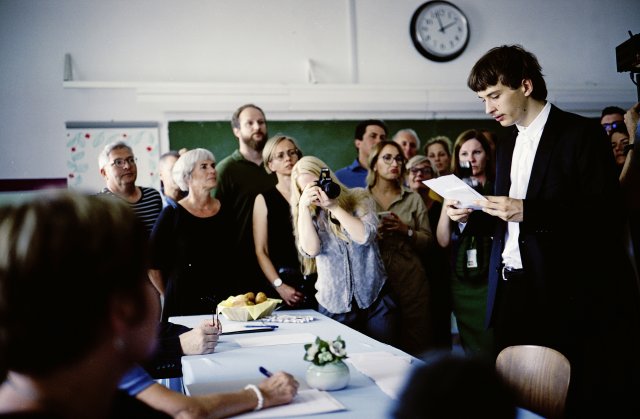
While MAGYARÁZAT MINDENRE, which translates as “explanation for everything”, might seem like an exaggerated statement as a title, Gábor Reisz’s fiction does indeed manage to unravel the complexity of contemporary Hungarian reality. Abel is a student in the last year of high school, jaded like many, with his attention not all that focused on his schoolbooks. With his final exams around the corner, he will soon provoke a national scandal to avoid disappointing his parents’ expectations. Reisz’s subtle, refined script turns a summer coming-of-age story into a sharp, almost scientific, analysis of Hungary’s current political stalemate. The film’s non-linear structure gives voice to opposing factions which refuse to budge from their positions and are entirely unable to listen to any others. This lack of understanding is at the core of the film: family ties, romantic liaisons and public confrontations are all marked by incomprehension and misunderstanding. MAGYARÁZAT MINDENRE manages to transcend this grim picture and offers us, if not an explanation for everything, an idea of cinema where political engagement and empathy define aesthetic choices. (Rebecca De Pas)

BITTE WARTEN
Pavel Cuzuioc
Austria 2020, 86 min
Wed, 23.9., 7:45 PM
“There used to be phone booths on every corner,” says a customer. He is sitting on his sofa, talking to one of the cable technicians whose work leads Pavel Cuzuioc into a road movie through private households in Moldavia, Romania, Ukraine, and Bulgaria. While such an assessment may seem nostalgic or reactionary at first, there is far more to it than that. By observing the work of cable repairmen, the film also focuses on communication in regions marked by poverty, nationalism, and conflict – a delicate endeavor which director balances out with a sense of absurdity. The film constantly shows that this work to help bring people in contact with the world and friends neither stops conflicts nor prevents a sense of isolation. After all, the true communication tool present for all those visited by the repairmen is the camera. They talk about their life and thus a double sense of access develops: one that is concerned with access to people, and one that is concerned with access to the modern world. As telephone cables are itself threatened by extinction in the age of digitalization, the film asks the important question of whether life is in harmony with or at war with modernization. (Patrick Holzapfel)
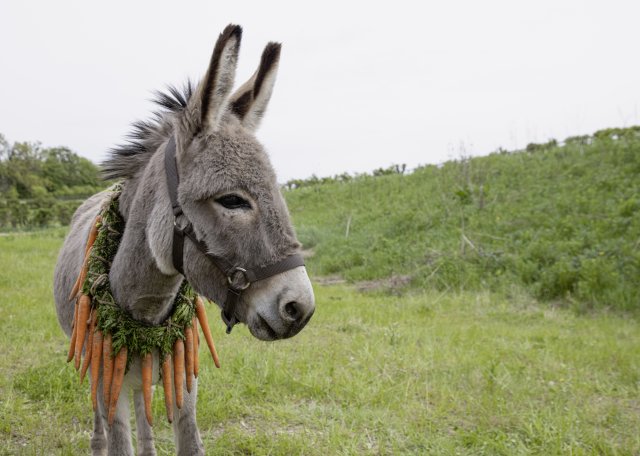
EO
Jerzy Skolimowski
Italy, Poland 2022, 88 min
Sat, 26.9., 7.45 PM
A donkey’s bray is incredibly loud. Meant for communication over rugged landscapes, it can be heard from a distance of several kilometers away. Nevertheless, nobody seems to hear EO’s cry. He is the enduring protagonist of Jerzy Skolimowski’s vivacious homage to working animals and nature. EO is a descendant of Bresson’s Balthazar, it’s through his eyes, repeatedly filmed in close-up, that we experience our own stupidities and limitations. When EO gets separated from the circus he used to work at, he longs for nothing more than to get back, suffering multiple injustices along the way in a world mostly ignorant of a donkey’s feelings. Skolimowski, who proves once more that it is the oldest directors who take the greatest formal risks, films EO’s journey through human civilization like Dante’s descent into hell: monochrome red, distorted lenses, images running backwards. The camera moves as freely as EO never is allowed to. There is a heightened sense of reality and of all living things. It’s only destroyed by humans entering the frame. EO embodies the hopeless dignity of observing without really being part of things. In this sense, the donkey’s gaze is easy to link to the cinema situation. The power of the film reveals itself as identification endures after the credits have rolled. (Patrick Holzapfel)
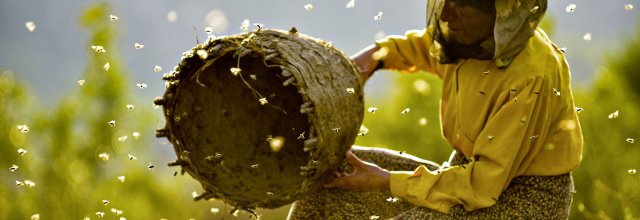
Medena zemja (HONEYLAND)
Tamara Kotevska/Ljubomir Stefanov
North Macedonia 2019, 86 min
Sun, 27.9., 6 PM
HONEYLAND is a vivid and multifaceted critique of unsustainable and greedy exploitation that revolves around Hatidze Muratova, the last keeper of wild bees in Macedonia, and her inspiring take on life and the use of natural resources. Throughout her life, Hatidze has earned her living by growing honey and selling it in the nearest town, following a simple, but fundamental rule: take half of the honey and leave the other half to the bees. This rule has been followed for generations, ensuring the continued existence of the bees themselves. However, this peaceful way of being and work ethic are upset by the arrival of Hussein and his family, and his entirely different approach to agricultural life. HONEYLAND is a sad and stirring tale of struggle, persistence, and change that insists on graceful respect for the natural world in an attempt to protect its vulnerability. It unfolds as a quiet, intimate, and intense portrait, exposing the fundamental tension between progress and tradition; between a philosophy for harmonious life and its sustainability versus reckless growth and the pursuit of profit. (Nico Marzano)
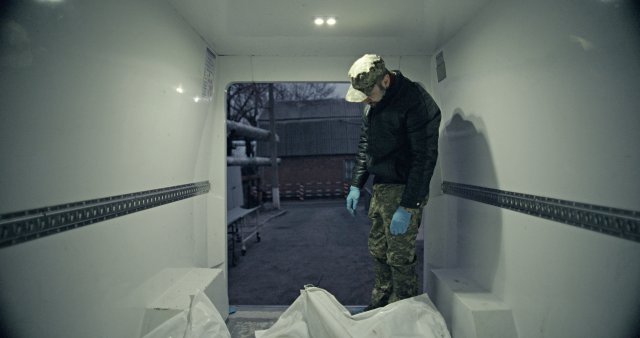
DEAR BEAUTIFUL BELOVED
Juri Rechinsky
Austria 2024, 93 min
Mon, 12.10., 8 PM
Unlike the media images of Russia’s invasion of Ukraine, Juri Rechinsky’s powerful, deeply compassionate documentary DEAR BEAUTIFUL BELOVED takes viewers onto the sidelines of the war. While men fight at the front and women and children attempt to flee to other countries, the elderly and sick often stay behind or are evacuated to hospitals in conflict-free areas. Soldiers who die on the battlefield go the opposite way: their remains are returned to their homes and families. Focusing on the relocation of the elderly and the transport of fallen soldiers, the film highlights the tireless, conscientious and often dangerous work of those behind the scenes taking care of others. Sensitively interweaving different storylines, Rechinsky’s precise camerawork portrays displacement, separation and bereavement with restraint, keeping an appropriate distance from his characters to respect their pain and sorrow. Amid the chaos, he looks for signs of solidarity, affection, humour and resilience. Thoughtfully observing the intimacy that arises from human interactions—a glance, a word of comfort—he demonstrates that benevolence and humanity still exist, which is nothing short of miraculous in the midst of war. (Maria Giovanna Vagenas)
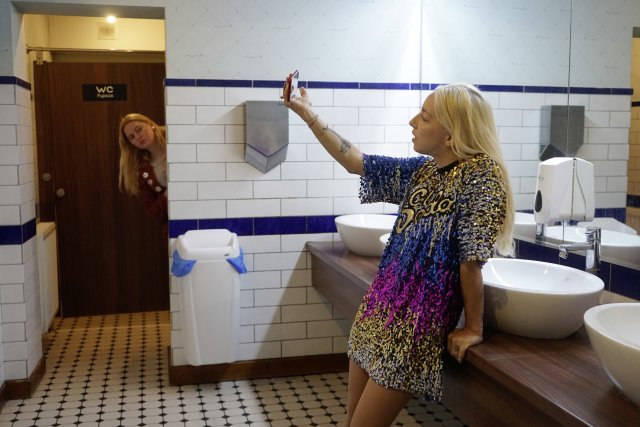
Nu astepta prea mult de la sfârșitul lumii (Do Not Expect Too Much from the End of the World)
Radu Jude
France, Croatia, Luxembourg, Romania 2023, 164 min
Tue, 13.10., 7:45 PM
In his latest film, Radu Jude has chosen extraordinary actress Ilinca Manolache to play a character on a mission: to find and cast one of the various employees of an Austrian company based in Romania who have suffered accidents due to the company’s negligence; the lucky worker will play the central role in an institutional “film”. Most of the story consists of Angela’s various trips to meet with these victims, driving through the city while arguing from time to time with her superior on the phone and on breaks filming herself with a filter that turns her face into that of an uninhibited, chauvinistic man ranting at the world. Jude adds another symbolic counterpoint to this dialectical game by editing in fifteen sequences from the 1981 film ANGELA MERGE MAI DEPARTE by Lucian Bratu, whose protagonist is a woman taxi driver. The result is a film that functions as a merciless criticism of how 21st century capitalism even alienates those who have given their approval to be exploited, a contemporary portrait of Bucharest in which its dispersed microphysical violence is felt without being spoken out loud and an oblique essay on the relationship between memory and the perception of reality and images. (Roger Koza)

Savvusanna sõsarad (Smoke Sauna Sisterhood)
Anna Hints
Estonia, France, Iceland 2023, 89 min
Sat, 17.10., 8:30 PM
A group of women are going through standard sauna rituals: pouring water on the heated rocks, washing, talking and hitting and massaging each other with birch branches. This same group is recorded for around a year, across all four seasons. It begins in the winter: heat inside, snow outside. As we see the women running towards a winter pool carved into the ice wearing nothing but wool socks, there is something about the change in temperature that goes beyond mere hot and cold, it has more to do with a feeling, a bodily sensation: the contraction of the skin and blood vessels, the way the air passes through the lungs, how voices bounce around in space. Over time their conversations expand and deepen, as they move towards a disentanglement of their gender roles, approaching the habitual intimacy of the sauna sessions as a way to reflect on their common experiences as women with families, on love, life, death and violence. Watching this unfold so neatly illustrates one of cinema’s enduring qualities: to make us aware of what happens when the same things are repeated over days, weeks and months, its condensed form allowing us to trace changes that would otherwise be imperceptible. (Lucía Salas)
VIENNALE GOES CEE stands for cinema that transcends borders: poetic and political, personal and universal. Films that open up new perspectives, make forgotten stories visible, and keep the dialogue between Vienna and Central and Eastern Europe alive.