
BY EVA SANGIORGI
Massimo D’Anolfi and Martina Parenti have been working together for almost twenty years now, a shared career that can be interpreted as a series of phases marked and given structure by the titles of their films. Examining their entire body of work, one finds it continually enriched through references, the duo’s typically in-depth analyses and various self-citations, which function like a methodological illustration of their approach. And while their aesthetic reflections reveal significant conceptual and formal progression across their oeuvre, their cinema has from the very beginning explored essential questions that only grow deeper and more complex with experience. Their cinema always looks back, building its conceptual and formal architecture on this kind of game of mirrors and comparisons. At the same time, it always feels open, and is eager to free itself from its own definitions.
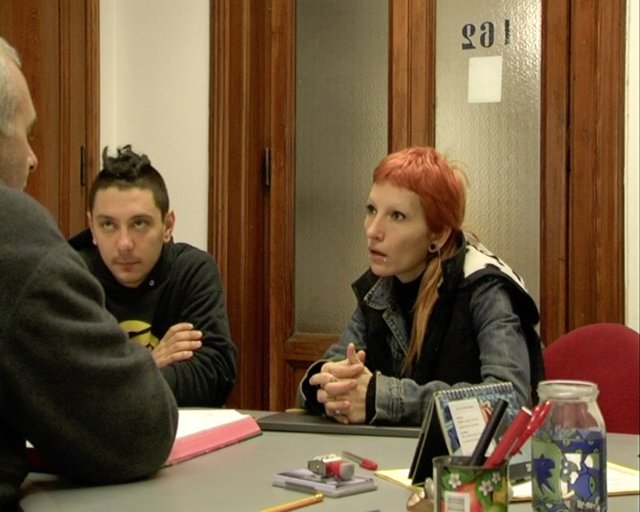
D’Anolfi and Parenti’s first works draw their inspiration from the titles of great novels and offer a depiction of today’s society through minute details of human interactions within systems. PROMESSI SPOSI (2007) takes its title from the iconic Italian novel of the same name by Alessandro Manzoni and shares its irony, which becomes true human comedy in the hands of the directors. It portrays a series of characters bound by the institutions, logic and bureaucracy of pre-marital procedures in Italy. And it offers an affectionate, albeit critical, picture of a country drained by legislative laboriousness and bureaucratic pedantry that are to the detriment of anyone wanting to build a future.
In GRANDI SPERANZE (2009), they follow three young entrepreneurs competing to reach a turning point in their careers. Here too we find ourselves before an ironic chiaroscuro of a particular cross section of Italy: the world of its young entrepreneurs with their commercial formulas and ambitions of easy success. To many viewers, the panorama might seem unpromising, but the directors bring an observational device into play that offers an important revelation about their work. Here the footage shot by one of the main characters, which is filmed as a personal travelogue in amateur fashion, is integrated into the main narrative. The cinema of D’Anolfi and Parenti is always rich in perspectives, which can extend to the mechanical or even superhuman, and include a diversity of formats and sources.
IL CASTELLO (2011) is a choral film that covers a year at Malpensa International Airport in Milan, structured around the changing of the seasons. The situations captured are sometimes dramatic, and at other times comic, and the directors’ perspective is joined by that of surveillance cameras and inspection devices. In this alienating space where real life is suspended—hence the reference to Kafka’s novel of the same name—everything takes place in interior environments, from the cockpit to the control zones and concourse areas.

MATERIA OSCURA (2013) exposes the irreparable environmental consequences of the activities carried out at the Salto di Quirra test range in Sardinia, where armed forces from across the world have been conducting a wide array of military experiments for decades. This is a film about the land, but also one that grapples with the complexity of representing the intangible, and allows the directorial couple to explore their discourse on multiple levels. The three parts that make up the film do not follow a seasonal cycle like the previous one, but each concentrate instead on an area of interest typical of their cinematographic practice, which over time become concrete tools and symbols of their resistance. A geologist devoted to tracking down the evidence of contamination caused by the explosive devices illustrates the conduct of science, one of the driving forces of their cinema. We also find a section focused on the archive—in this case, one containing images of the military depot. And then there are the extremely harrowing observations of the work and daily care carried out by two local farmers affected by the consequences of the pollution. The film painfully opens an investigation into the relationship between humans and their surroundings that they then develop in different ways in the films that follow.
This pain is counterbalanced by a kind of antidote in the form of SPIRA MIRABILIS, which premiered in competition at Venice in 2016. When describing their method, the directors have revealed that each new film begins from the end of the previous one: to continue it, deepen it or even create distance from it. In terms of language, too, the couple vary the tonalities and grammars they employ, which in turn reference various cinematic possibilities and genres. The film’s five episodes map onto the five elements: water, earth, air, fire and ether, but the editing alternates between them to form a game of mirrors that creates a complex web of citations and references. The filmic forms they use to this end are free and varied, just like the thematic elements they explore, which are drawn from distant worlds and cultures. All are attempts to approach the theme of immortality. On a cinema stage Marina Vlady reads out the short story “El inmortal” from Jorge Luis Borges’ collection El Aleph, while the projector creates an interplay of light and shadow around her. It is an homage to cinema and one of its divas, crowned by Borges’ prose.
The first two episodes frame the film, with the other three intercalated between them, creating a spiral formation: an endless geometric figure that permits continuous returns. This film also makes a methodological intention explicit, to free itself from the dynamic of conflict and aspire towards a more organic narrative development as inspired by the Fibonacci sequence. Here, “earth” is represented by stone: a material transformed by human endeavour. The directors follow the restoration of a statue from Milan Cathedral to this end, a meticulously controlled process that offers myriad perspectives for reflection. So much so that it led to a film of its own, which examines all the details of the magnificent Italian cathedral, from its origin and construction to its current management.

As the ambitious SPIRA MIRABILIS project required a greater amount of financing, L’INFINITA FABBRICA DEL DUOMO (2015) actually ended up being completed a year earlier. The monumental work of architecture at its heart is symbolically inseparable from the idea of immortality, which is embedded in its intentions and is strikingly embodied by the fact that it remains perpetually incomplete due to the very scale of its ambition. Begun in 1386 at the initiative of Gian Galeazzo Visconti, its construction continued for about six hundred years, until the mid-twentieth century, and it continues to be endlessly restored. D’Anolfi and Parenti’s primary aim is to highlight how nature is transformed by human actions: from the colossal Candoglia quarry to the closing of the cathedral at sunset, the banality of everyday activities, the methodical work of craftspeople and the endless organisation of the administrative procedures around a never-ending construction site. In this film, we see the directors’ ability to blend two different temporary orders: the course of history and an expanded view of the moment. The narrative also makes use of captions, a device only used sporadically in their work. In this case, their inclusions permit another conceptual layer that refers directly to methodology—namely the use of sources, texts and archives—with citations drawn primarily from Milano in mano by Guido Lopez and Silvestro Severgnini and Storia della Veneranda Fabbrica by Carlo Ferrari da Passano.
Milan also remains the setting for their subsequent short film BLU (2018), in which D’Anolfi and Parenti descend from the cathedral’s pillars and spires that strain towards the sky to the earth’s depths, following the construction of a new line for the city metro. Here we see the workers, technicians and engineers at work in a surreal, “extrahuman” habitat only made possible by machines and technology.

With the title of 2020’s GUERRA E PACE, the directors once again reference a great work of literature. Entirely different in terms of its perspective on war, yet equally all-compassing in scale, the film is a powerful reflection on the responsibility of images and those who use them professionally. Cinema is deeply implicated—the archive is not innocent and no gaze is without intent. Four European institutions participated in the film, each one the subject of a chapter. The ones dedicated to two state archives serve as a frame: the Istituto Luce in Rome, which preserves and restores the first filmed images of war, shot during the Italian invasion of Libya in 1911, and the Swiss Film Archive in Lausanne, which preserves footage shot by the International Red Cross: raw images of the horror wreaked by conflict on civil society. The two chapters in between focus on current events from two very different perspectives: the crisis unit of the Italian Ministry of Foreign Affairs, which brings Italian citizens to safety in emergency situations, and the Etablissement de Communication et de Production Audiovisuelle de la Défense (ECPAD), the audiovisual wing of the French Ministry of Defence, where young soldiers learn to create images in conflict zones. The film makes explicit an argument that had been slowly maturing in the directors’ work and finds full expression in their most recent film: the archive as reference and resistance in political discourses both powerful and very human. Sometimes the images are almost too harsh to watch, which lead D’Anolfi and Parenti to project them onto different surfaces, almost as if to modulate the violence. The two directors rely on the active participation of the spectator, to whom they entrust the duty and the right to create their own mental images inspired by those of the film.
This call for an active spectator and for dialectical and shared reasoning between film and viewer is also evident in the different formal devices used in UNA GIORNATA NELL’ARCHIVIO PIERO BOTTONI (2022). It also introduces an interesting variation on how to approach sources. In a room in the Cineteca in Milan, Giancarlo Consonni and Graziella Tonon, leading experts on Piero Bottoni and the ones who commissioned the film, talk about the life and projects of the multifaceted architect and city planner. They include the QT8 district, an urban utopia for a Milan rebuilding itself from the rubble of World War II, or Monte Stella, a man-made hill that made it possible to view life in this working-class quarter from a new perspective. They serve as counterpoint to the images of recently digitalised footage shot by Bottoni himself, mainly on 8mm and 16mm, that belongs to the Cineteca archive. Here again we find captions used as a guide, which make it possible to include other sources, like Bottoni’s writings, with which they chose to end the film: “dream and poetry move the world, despite appearances.”